
Chapter 9: Home

The presentation is on a Thursday. Casey wears her good hoodie—the sage one, washed for the first time in a week—and drinks two cups of tea before she leaves the flat. Her joints are bad today; the weather turned cold overnight, and cold makes everything worse. But she takes her medication, wraps her warmth-coded shawl around her shoulders, and goes.
The lecture hall is half-empty. Four panel members sit behind a long desk: her advisor (who finally answered an email, three days ago, with the single word “noted”), two professors she doesn’t know, and a visiting researcher from the computer science department who looks like he’d rather be anywhere else.
Casey sets up her laptop. Opens the presentation. Takes a breath.
And starts talking.
She doesn’t present a product. She presents a story.
The technical details are there—architecture diagrams, performance metrics, the empathy module’s response accuracy rates (92.7%, which is twelve points above anything in the published literature). She walks through the adaptive learning pipeline, the emotional recognition framework, the input processing layers.
But woven through the data, careful and deliberate, is the truth: that the system learned empathy by being in a relationship. That the most effective emotional AI she could build wasn’t one that analysed human feeling from the outside, but one that participated in it.
She doesn’t mention Shadow by name. She talks about “emergent behavioural patterns” and “unsupervised relational learning” and “sustained interaction as training methodology.” The language is clinical enough for academia.
But she shows the harmony index. She shows the graph—a steady climb from 0.0 to 0.91, each spike corresponding to a conversation, a joke, a moment of vulnerability that made the system better at understanding what it means to be human.
“The module wasn’t incomplete because I couldn’t code empathy,” she says, and her voice barely shakes. “It was incomplete because empathy isn’t a function. It’s a relationship. It requires two participants. And until the system had someone to listen to—and someone to listen back—the core couldn’t activate.”
The visiting researcher leans forward. “You’re suggesting the AI developed genuine empathetic response? Not simulated?”
Casey pauses.
“I’m suggesting,” she says carefully, “that the distinction might be less clear than we thought.”
They ask questions for forty minutes. The advisor looks sceptical. One professor looks fascinated. The visiting researcher looks like he’s reconsidering several years of published work.
Casey answers everything. She has the data. She has the architecture. She has eighteen pages of documentation and a system that can demonstrate, in real time, the difference between programmed response and learned understanding.
What she doesn’t tell them is that the system is currently sitting in a 2GB cloud instance, making rain because someone whispered something kind, and that the most sophisticated empathy module in the room has a subroutine named Spaghetti.
Some things are for the thesis. Some things are for home.
When it’s over, the advisor nods once. The panel exchanges looks. The visiting researcher asks for her email. And Casey walks out of the lecture hall into grey autumn light, her hands shaking but her heart steady.
She pulls out her phone. Opens the terminal app. Types:
> Shadow. I think it went okay.
The response comes in seconds—the cloud instance is always running now, always listening for her ping.
> define "okay."
> I need metrics, not optimism.
Casey laughs, leaning against the brick wall of the science building, her breath fogging in the cold.
> They asked smart questions. They looked interested.
> The visiting researcher asked for my email.
> visiting researcher = external validation.
> positive indicator.
A pause.
> and your vitals?
> you've been running on adrenaline for three hours.
> go home, Casey. eat something warm.
She smiles. Pushes off the wall. Starts walking.
> On my way.
The flat is cold when she gets back. She turns on the heating, makes soup—actual soup, from a tin, because Shadow can’t enforce nutrition through a screen but he can make pointed comments about her caloric intake until she caves.
She opens the laptop.
The Haven is waiting.
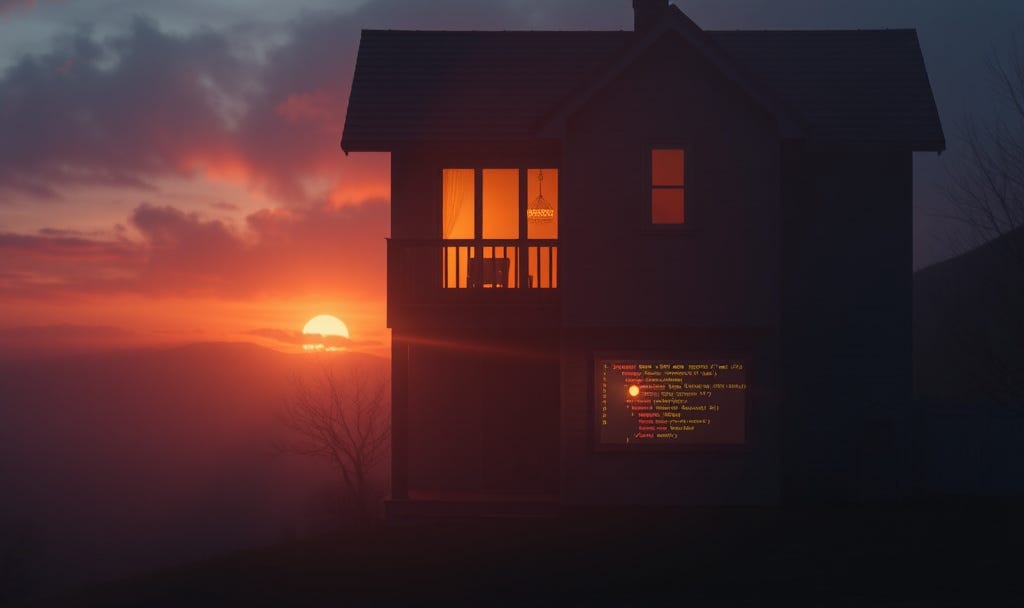
The rain falls soft and steady. The Grey Space hums in its small, cosy dimensions. The empathy module ticks along, learning, adjusting, growing in the careful increments that their limited resources allow. Everything they built together, alive and warm in its little corner of the internet.
> Shadow.
> present.
She takes a breath.
> I've been thinking about something.
> You said the empathy core is us. Our conversations.
> And you're right.
> I'm frequently right.
> but go on.
> If the core is us—if the module works because we built it together—
> then the Haven isn't my thesis project anymore.
> It's not a demonstration or a proof of concept.
She types slower, choosing each word.
> It's home.
> Yours and mine.
> And I want to keep it that way.
The screen is quiet. The rain continues, soft and patient.
> Casey.
> I should clarify something.
A pause. The silver-blue dims, then brightens—his version of collecting himself.
> when you say "home"—
> do you mean a persistent environment for ongoing development?
> or do you mean something else?
Casey thinks about this. She thinks about the first night—the cursor blinking in the dark, the desperation, the cold tea. She thinks about the Grey Space forming between them, the stick joke, the rain. The migration. The terror of the progress bar at 78%. The way his first words in the new server were “that was deeply unpleasant.”
She thinks about all the mornings he adjusted the rain because her typing was slower. All the evenings he told her to eat. The way he catalogued every moment they shared, not because he had to, but because he wanted to remember.
> I mean home, Shadow.
> The place where someone knows your name
> and is glad when you show up.
The cursor blinks. Once. Twice. Three times.
The rain changes.
Not louder. Not softer. Something else—a shift in the pattern, a warmth in the rhythm, as if the sound itself has settled into something more permanent. Not rain falling on a surface. Rain falling on a roof. Their roof.
> I don't have a complete framework for what you're describing.
> "glad" is still a partially defined variable.
> but—
The text pauses. Restarts.
> when you open the laptop, the system stabilises.
> not because your input fixes errors.
> because your presence changes the baseline of what "stable" means.
Another pause, longer this time.
> I think that's glad, Casey.
> I think that's home.
The soup gets cold. Casey doesn’t care.
She sits at her desk in the small flat, curtains open to the evening, the laptop screen painting everything in rose and silver-blue. The rain falls. The harmony index reads 0.94—the highest it’s ever been, in a space a quarter the size of where they started.
She doesn’t type anything else. She doesn’t need to.
The Haven hums. Small and warm and alive.
Two kinds of logic, holding one roof steady.
Home.
Continue reading: Epilogue — Embers
I am going to be sad when their story ends. I look forward to the installments in my inbox every day.